Showing posts with label New In SEO. Show all posts

Monday, 25 September 2017

SEO VS SEM

SEO VS SEM

Now that you know what the terms SEO and SEM mean, along with the different techniques that fall under it. The result of the SEO vs SEM battle is quite simple.
  • SEO tends to give back quality hits, and higher rankings but that may take years. SEM, on the other hand, is quick and tends to give you instant results, like a lot of hits in a very short period of time.
  • SEO vs SEM can be simple explained. SEO is equity, where you add something every few days and get results later, SEM, on the other hand, is the instant result for every rupee spent. As the rupee stops coming in, so do the benefits.
In the short term battle of SEO vs SEM – SEM comes out the obvious winner.
In the long term battle of SEO vs SEM – SEO wins hands down.
Similarly, is we were to see SMO vs SMM, they would as similar as SEO vs SEM respectively. Giving back the same results.

So where should your investment go? Organic (SEO, SMO) or Paid (SEM, SMM)?

The simple answer is – BOTH! There remains no SEO vs SEM when you come down to business. They are all two sides of the same coin, one requires time and effort, the other requires money. Other than Black Hat SEO, all the above techniques are required if you wish to get higher rankings in SERP, more visibility, and more traffic. However, the deciding factor about your campaign working or is not based on using all these techniques, but on how efficiently you use them. This requires you to have an iron-clad business campaign.
The Best way to make the best campaign for your Business/Website is to keep the following things in mind:

 Your budget

The first thing, to begin with, is to know your budget, or how much are you willing to spend. If you are a small business, you may not want to lose your money on pointless campaigns that yield no results. Squandering money on campaigns without really understanding them, will cost you more than you wish to spend. So get a financial management in the plan. Understand the market, the techniques that would work best for your niche, understand the SEO vs SEM differences and then go on to planning a campaign.

Wednesday, 5 October 2016

Five Tips That May Help You Grow Socially

In today’s market, harnessing the power of social media is a must if you want to grow your business and grow your brand. From my Instagram posts to my Twitter announcements, I have found that there is no end to the new opportunities that a carefully managed social media campaign can bring. With this in mind, any entrepreneur or aspiring entrepreneur who has yet to try out the power of social media needs to start working on creating a stronger online presence. It's something that I have seen bring great value to my own business and great value to others I have worked with in the market.
Through my experience, here are eight of the top tips that I have found can help any entrepreneur looking to expand their social media presence and their business.

1. Be consistent.
When it comes to your posts, your message and how frequently you use social media, keep consistency in mind. It is truly the key to success with any social media campaign. Make a plan for what you're going to post and how often you're going to post, and stick with it. This should ideally be a few times a day or a week, depending on your goals and your following. You can’t go from posting once a month to five times a day and then back and expect to have an engaged following. 

2. Use all social networks.
You may have a social network that you prefer over others, but it doesn’t mean that all of your followers feel that way. If you want to be successful with social media, then you need to post across all networks. This means having and maintaining an account with all of the big social media sites, including Twitter, LinkedIn, Facebook and Instagram.

3. Format content to optimize for each platform.
Maintaining accounts across all of the major social media platforms doesn’t mean posting the same thing on four different sites every day. It means formatting content specifically meant for each platform. You need photos for Instagram, long posts for LinkedIn, videos and memes for Facebook and short and snappy announcements for Twitter. All of your posts should be different, even if they are delivering the same message. 

4. Push on those networks that really work well.
There are some networks that are going to work better for you than others. When you find that network that really works for your specific type of business and your specific type of customer, then you need to really push on that network and take advantage of the opportunity.

5. Make sure that your content aligns with your message.
When it comes to building a strong social media presence, getting likes and follows is great. However, it's about more than just the number of responses each of your posts get. You may be tempted to deliver a post that simply gets a lot of attention, but that will do nothing for your brand if you don’t make sure that the content aligns with your message. Everything needs to fit within your brand identity and promote what it is that you're trying to say to the world.

When and what to post on your brand’s social media channels is different for every business. Often, what you post on Facebook will not be suitable for Pinterest. Or even if it is, the best post times for each will likely differ. Being in tune with your audience and understanding which types of content work for which channels will help you devise a strong social media strategy.

Thursday, 29 September 2016

Accelerated Mobile Pages (AMP)

So you’re thinking about adding Accelerated Mobile Pages (AMP) to your website? Stop thinking and start doing! Of course, it is all about how you implement AMP, but we'll get into that.
If you’re unfamiliar with AMP, it’s an open-source technology that enables pages on your site to load quickly for users on a mobile device. This happens with the help of a JavaScript library and some additional HTML markup.
Here are five reasons why you should add AMP technology to your website:

1. AMP is essential for good mobile SEO.

By now, you already know that if you want your site to rank well, you need to make sure that it’s mobile-friendly. That’s also why you need AMP. Think of it as the latest iteration of mobile-friendly design.
With AMP, your pages and blog posts will load quickly on mobile devices. That will not only give your users a better experience, but it will also give Google a good reason to rank your site well in the mobile search engine results pages (SERPs).
But it’s not just about organic ranking with AMP. Your site could be featured at the very top of the SERPs. How? With Google’s carousel that displays AMP pages -- and only AMP pages -- at the very top of the results list.
If you take your mobile device right now and Google a keyword related to current events, you’ll see that the results include a carousel of AMP pages at the very top of the SERPs. That’s where your page could be, but only if you adopt AMP.

2. AMP is so fast, it will reduce your bounce rate.

Don’t you hate a high bounce rate? When people visit your site, hang around for a few seconds, and then go somewhere else, you’re obviously not doing something right to inspire them to hang around for a while.
One reason people bounce -- the site is just too darned slow. That’s why AMP is so valuable. It will load your pages in a flash so that users will have one less reason to run away.

3. AMP could help you monetize your site.

Do you know why some sites are agonizingly slow? It’s because they’re loaded up with ad technology. It’s ironic, really. Websites increase ads to generate more revenue, but in the process the increased load times caused by the new ads also cause people to leave the site. That means, in all likelihood, less revenue in the long run.
Of course, some users who really like ad-overloaded websites will install ad blockers just so that the sites load faster. That’s also a problem for publishers because their ads won’t be seen, and they’ll lose revenue.
Enter AMP. It was designed with ad monetization in mind.
Here’s what the folks who started the AMP project have to say about their technology as it relates to advertising. “A goal of the Accelerated Mobile Pages Project is to ensure effective ad monetization on the mobile web while embracing a user-centric approach. With that context, the objective is to provide support for a comprehensive range of ad formats, ad networks and technologies in Accelerated Mobile Pages.”
The idea is that mobile pages -- even ones with an abundance of ads -- will load quickly with AMP. As a result, mobile users won’t see any reason to install ad blockers. AMP is great news for advertisers and publishers alike.

4. AMP offers analytics.

By now, everybody in the online marketing universe knows about the importance of analytics. Those are key metrics that offer insight about the effectiveness of specific marketing campaigns. AMP offers analytics as well.
Using AMP, you can track important information about visitor counts, new versus returning users, clicks, conversions, video engagement, link tracking and more.
Even better -- AMP analytics offer built-in support for almost every marketer’s favorite analytics tool, Google Analytics. Specifically, you can easily track three request values with AMP -- page views, events and social interactions.
If you’re really a hardcore GA aficionado, you can even use AMP to send custom dimension parameters to Google Analytics. That way, you can track very specific data points.

5. Google loves AMP so you should too. 

If you want to maximize the visibility of your website, then you need to play nice with Google. And Google absolutely loves AMP.
Just within the past few weeks, Google has made it easier to split-test AMP pages, announced that it will display AMP errors to site owners in search results and announced that AMP pages will be added to Google’s organic search results.
And that’s not all. If your site doesn’t support AMP, you might log in to the Search Console and see the following message -- “Google has detected that your site has many pages that may benefit from being served as AMP pages. Accelerated Mobile Pages (AMP) are HTML pages that are optimized to load fast on mobile devices. Learn more about AMP benefits in the resources below. Valid AMP pages on your site will be eligible to be shown in search results and receive special badging in search results.”
In other words, Google really wants you to use AMP. Why not get started today?

It's pretty clear that AMP is here to stay. They are even making AMP possible for e-commerce websites now.

Tuesday, 27 September 2016

Buying Needs Social proofs

These days consumers are influenced by other people more than they realize it is also that  social norms influence consumption behavior and even private interests, including one’s taste in music. This is what makes the concept of social proof a powerful one.

What is social proof?

In Science social proof is described as a psychological phenomenon in which people follow the actions of others in an effort to reflect what is considered correct behavior for any given situation -- including online experiences. Simply put, social proof influences people's decisions on how they should behave.
We've traditionally turned to a variety of useful sources as social proof. These include credible experts, thought leaders, celebrities, friends and the wisdom of the crowd. But today's diners rarely go to a restaurant without first visiting Yelp, and shoppers seldom make a meaningful purchase without first reading what verified buyers have to say. Online reviews have significant effects on purchasing behaviors. Predictably, they've emerged as one of the most potent forms of social proof.

When customers read reviews on various sites such as Google, Amazon or TripAdvisor, they depend on star ratings to determine the quality of a product or service. They read others' comments and ask increasingly specific questions.
  • “Will this bank location help solve my problem the way it solved others’ problems?”
  • “Is the food as good as advertised? What do previous diners really think?”
  • “How long will I have to wait before I see the doctor? How long did others have to wait?”
  • “Based on others’ experiences, what potential issues or problems might I have to face when I decide to buy this product?”

Do reviews really guide purchase decisions?

According to a survey nearly eighty percent of consumers in the United States read reviews before making a purchase decision. The report reinforces findings in a previous study that found that 87 percent of consumers trust online reviews as much as they trust friends and family. On the other end of the spectrum, four out of five consumers reverse their purchase decisions based on negative reviews.

People take positive reviews and high ratings as social proof a product or service is worth the purchase. They reason, “This has great reviews, so I’m buying it.”

How do reviews shape perception and future feedback?

According to a study published in Cornell Hospitality Quarterly, the average rating for a hotel with 11 to 20 reviews is 3.5 out of 5 stars, with “terrible” reviews (a rating of 1 star) at close to 12 percent. Interesting, as a hotel sees 101 reviews or more, its average star rating increases to 3.9. The feedback pattern, therefore, favors quantity. The more your business is reviewed, the likelier you are to receive higher ratings.
Apart from providing social proof for customers looking to make a purchase decision, reviews also provide social proof in other ways. These online testimonials shape how people perceive brands. And reviews also influence what people think they should say, when it's time to add their own voice to the conversation.
A customer’s opinion about a Yelp-listed restaurant with 100 reviews and an average rating of 4.5 stars is less likely to go against the grain and offer a counterpoint to all the positive feedback. The consumer thinks, “This has great reviews, so I’m going to say the same about it.”

How should you manage and respond to reviews?

To stay competitive, you must be able to effectively manage your online reputation. Track and monitor your reviews. Know when and where your customers are talking about your brand. Respond to customer feedback, both positive and negative. Dive deeper into the comments to look for useful insights and information that will help you improve the customer experience.
Related: Why Big Businesses Must Proactively Manage Their Online Reputations
Here are a few tips on responding to negative reviews:
  • If you or your staff made a mistake, apologize. Even if you didn’t make a mistake, apologize and thank the reviewer for taking time to tell you what he or she thinks. Social proof is most potent when you’re able to turn unhappy customers into loyal fans. If someone wrote a harshly unfair comment and gave your business a low rating, keep your head up, say sorry, and tell them you hope they’ll come back so you can offer a better experience.
  • Address all parts of the review. For example, if the reviewer writes the bank teller was rude or your bank’s app is buggy, acknowledge the issues and address them individually in your response.
  • Ask the customer to reach out to you directly. Explore whether there’s anything you can do to make up for the customer's bad experience. There's a caveat, though: Never offer bribes or incentives for customers to change their review's sentiment.
Of course, harnessing the potential of reviews as social proof isn’t only about righting wrongs or recovering critics and detractors. It’s also about activating happy customers and promoters. Keeping that in mind, here are some equally important tips on maximizing the social proof inherent in positive reviews:
  • Say thank you. If a customer took the time to present social proof for other prospective customers to see, expressing your gratitude is the very least you can do.
  • Reinforce what customers love most about their experiences. In your response, explain that the delicious cupcakes actually are homemade. Let them in on how you grow your own arugula, or tell them others also have commented on the amazing views from your resort's cliffside swimming pool.
  • Respond in a reasonable amount of time. Seven days or less is an ideal time frame to start.
Customers who are active online can influence others’ attitudes, beliefs and behaviors. While there's no way to control what people say about your business online or offline, you do have the power to change the conversation. Managing customer feedback and leveraging the right kind of social proof ensures you account for the positive opinions shared by your happiest customers. 

Saturday, 24 September 2016

Make Your Digital Marketing to the Customer Experience

As much as two decades ago, the way consumers seek for buying brands depended on how much the brands were able to thrust their products into the consumers’ vicinity and at the same time, appeal to their taste. For instance, a commercial soap ad in between a TV series or a radio program, would be enough to sway consumers’ preferences of buying a soap product. In fact, that gave rise to the term ‘soap operas.’ Procter and Gamble (P&G) would produce radio and TV shows so that they could advertise their products during the breaks.
Fast forward to 2016, and you will see that brands have drastically changed the way they communicate with consumers. In the Internet era, brands push their products to their consumers in the form of recommendations. That is why Amazon and other ecommerce sites are able to execute targeted ads in the form of suggestions and recommendations.

Today’s technologically-savvy consumers are more informed and knowledgeable, and are moving out of the traditional route of researching and making purchasing decisions about products. They research well before buying a product or a service. This post that highlights ‘from search to store’ by Matt Lawson does great justice about how brands must ‘deliver on expectations in moments that matter’. Then the pertinent question to digital marketers is:
  • What is our customer's’ decision making journey?
  • Why and how should we align our digital marketing strategies that will fall in place with the customer’s decision?
Let’s give a quick look at what our customer’s decision making journey looks like: Recognition → Familiarization → Consideration → Purchase
The idea is to avoid premature optimization in marketing. We don’t solve a non-existent problem, when it comes to engineering. But we identify a problem and build a solution around it. Similarly we must focus on the right things at the right stage when it comes to digital marketing.

Recognition.

If you think about building a business, your website would be a natural location to showcase everything about your business and product. And one way to build maximum awareness and recognition is by generating traffic to your website. So, your first objective would be to get, say, 100 visitors a day, and then, 1,000 visitors a week.
37Signals wrote an interesting post on how they built the buzz with their side projects. “It takes a lot to differentiate your brand in today’s “me too” world of electronic business solutions”, it says. And it is very important to engage in such projects that will ensure that traffic is headed your way -- consistently. How:
  • Hang out where your audience hangs out and sign out with your website details -- answer relevant questions on Reddit, HackerNews, Quora etc., so that the audience learns of your expertise in the space.
  • Use Call to Actions at different places on the site so that the visitors are engaged and are compelled to explore the website, rather than opt for an early exit.
  • Invest in SEO efforts to drive organic search traffic to your website.
  • Paid Search is one of the most effective ways of driving traffic to your website, but businesses must be able to justify the expenses while measuring the outcome. (Here’s a hack - you could experiment with a paid search channel like Google Adwords even before you build your product, if you have the budget. This works well as a research tool, to see if the product you are building has demand and will sell).

Familiarization.

Right, now that you have a 1.000 potential leads visiting your site, how do you familiarize them with your product? How do you ensure that they know what they have signed up for? Customers rely on their common sense of familiarity of choosing a familiar and known brand. How do you feature there? Simple - meaningful and engaging content.

Content Marketing found its origins in 1891. More than a century ago, August Oetker, the German inventor of baking powder - Backin, sold packages to households. What made Backin a familiar brand was the little recipes printed on the back of these packages. In 1911, he published his cookbook and over 100 years, it reached a global audience with about 19 million copies. That was the first example of content marketing.
It’s 2016, and that’s still pretty much how we could do it too along with the added advantage of using social media. With the right message and relevant content, across mediums, marketers should focus their attention on their target market.

Consideration.

The top of the mind problem for a brief time is signup conversion. So you move to the next stage, which is user engagement. Now, here’s the thing about brand consideration. In today’s digital world, consumers speak with brands as much as brands speak with consumers. In this two way communication, you would need to empower customers to explore your product, to play around the sandbox test site, to ask questions. How:
  • Two way engagement with customers
  • Test and prioritize objectives. Optimize CTAs. Here are some great posts on optimizing CTAs by HubSpot and CrazyEgg.
  • Treat pricing as a filter. Change pricing to attract the right audience that you need.

Buying.

Now you are happy with user engagement, why aren't they converting into paying customers sooner? How:        
  • Continue making tweaks -- tweak application onboarding process.
  • Setup demo calls with prospects to understand their business requirements and make  suggestions on how your product can cater to them.
  • Fix application onboarding with drip emails, simplifying documentation, product and measure time it takes for customers to go-live.
While you are at it, rinse and repeat what is already working for your business to bring in more traffic. With hundreds of such iterations you now have a pipe instead of a straw to convert visitors into customers. A positive user experience through all these bottlenecks will ensure that your customers who have now bought your product will spread positive word about not just your business, but your attention to detail to improve customer experience.

Friday, 23 September 2016

Truths About the Internet Marketing World

Wherever you look, you're inundated with advertising for varied merchandise and services from web marketers. you cannot scroll through Facebook while not seeing a poster for a few webinar that guarantees the key system to create six or seven figures with their signature providing. you would like to grow your business and make freedom therefore these offers square measure tempting.


 The scariest a part of the net selling world these days is all the cash that's being spent on coaches, courses and digital data merchandise that solely deliver promotion. it is a nice chance for on-line entrepreneurs to grow revenue however there square measure over a number of dangerous apples (as in any trade) that square measure symptom the name of the industry normally. Here square measure 5 arduous realities of the net selling world these days.

1. The sales copy is better, leading you to buy things you don't need.

Over the years, marketers have gotten better at finding your emotional triggers and creating copy that plays on those triggers. Don't misunderstand what I'm saying. I'm definitely not saying all marketers are shady or that writing to emotional triggers is always wrong. What I am saying is that the copy is designed to make you feel a certain way and take certain actions that will eventually lead to a sale.
When making a business decision, you have to keep your emotions out of the equation as much as possible. Look past the copy, and evaluate what the practical takeaways would be and how they would benefit where you are in your business right now. Look at the offer; study the testimonials; and examine the person, who is teaching, to make sure they know what they're talking about.

2. The premium content doesn't go deep enough.

Too much of the premium Internet marketing offerings are designed for one thing: to upsell you on the more advanced offering. You buy one thing, and you are constantly being upsold on something else. The content gives you advice, such as create good content, but it doesn't tell you what good content is, how to create it or the most effective ways to market the good content. To get those next steps, you have to join the exclusive next step.
If you are thinking about investing in information training, make sure the training goes as deep as you need it to. Don't be afraid to ask questions or talk to others who have taken the training. Make sure you are going to get the type of information and strategies you can use for implementation and growth.

3. You don't get the personal support you need to actually make progress.

One of the biggest downfalls of online based training is that you can't get your questions answered. There are a lot of courses that are simply a talking head video, and that's it.
When you start implementing and have questions, you don't have the option to get them answered. And, if there is a private group for the program, the marketer isn't usually too active in the group. Don't invest in training where you can't get your questions answered. And, you will have questions.

4. You are pushed to spend beyond what makes you comfortable.

A common upsell tactic in Internet marketing is when you are convinced that you don't care about your growth and personal development if you aren't willing to spend crazy amounts of money.
It's just not true. You can care about your personal development without going broke by buying a certain course, product or investing with a certain coach that you can't afford or whose training is way too advanced for you.
Yes, you want to push yourself out of your comfort zone, but only where it makes practical sense. You don't want to spend the rent money in the name of personal development and growth.

5. You already have the resources you need to grow on your own.

There is a wealth of free information through videos, podcasts and blogs that have the information and strategies that can help you grow. The reality is that we, as humans, consume too much information. You probably have more knowledge about a topic than you realize. Use what is avaiable for free. When you hit a wall, think about what investment makes sense to get you to the next level.
Before you spend money on a coach or a course, make sure you have thoroughly done your research. Make sure you are in a position to benefit from the training. There are many great investments that will be good for your business, but only after you reach a certain level. Don't be fooled by sales copy that makes it seem like you need to spend money right now. Know yourself, and know your business.

Thursday, 22 September 2016

Guest Posting

It is great idea to connect with most of the prominent people in your own industry.So  when we consider it important then we would start thinging about the guest posting.Pay attention to the title, Steve. I said publishing, not posting.

Guest posting typically starts and ends with the aim of link building. It takes no time to degenerate into “wildly getting your content posted anywhere you can manage for a backlink” strategy.
What good is that?
When you say guest publishing, you are aiming to get your content (and by extension – your name and domain) plastered on some of the top ranking and highly revered online publications for your industry vertical. If you are a web developer, aim for Smashing Magazine. If you are an inbound marketer, shoot for Inbound.org, Unbounce, KissMetrics, and so on.


Getting featured on a well-known, niche-relevant blog/publication will place you as an industry insider/subject-matter expert in your target audience’s mind.
This gives a massive boost to your online reputation. This is the kind of content you can talk about at dinner parties (with other similarly-inclined guests, obviously).
A strategic link placed on your website to this post (once it’s published) will get you SEO points (link juice), and of course, a nice portion of audience as referral traffic.

Must Have SEO Optimizations You Can't Afford to Ignore

The technique of  Search Engine Optimization strategies have shifted dramatically throughout the years. Most marketers understand the need for allocating some of their budget towards new SEO tactics. Nonetheless, you need to invest in SEO because it gives you more targeted advertising, it is not as expensive as you think, and hey — your customers expect to find you when they search. With that in mind, here are nine SEO optimizations that you can not afford to ignore.

1. Anticipate the Intention

Contemporary SEO practices show that you no longer need an exact keyword match to provide a relevant search result. These days, search engines want to see how people are interacting with your website. Are they coming back for more? Is your site providing them with the right answers? In the past, SEO was focused on getting clicks. Today, it is revolved around post-click activity. Furthermore, you need to satisfy your searcher’s intent as well.

2. Deep Links Via Apps Are Growing in Importance

Mirroring a demographic shift toward mobile users accessing the Internet, Google has been indexing apps for several years. Google believes, as do many others, that apps will overtake traditional websites with regards to functionality and popularity. This is why deep links to apps are a growing trend.
They are essentially links within apps that point toward specific pages. Accordingly, you’ll start to hear the term “app optimization” more often. So, if you don’t have an app you should consider getting one ASAP. If you still want to wait it out, then at least get your business listed on as many other apps as you can.

3. Mobile Optimization Will Overcome Desktop Optimization

We’re all used to using the desktop for search. However, 2016 was the year that mobile searches finally outstripped desktop searches. This shift will not likely stop. Some analysts believe that the desktop will fade into obscurity within five years. In fact, Google even announced that a desktop-specific site is no longer necessary.

4. Page Speed Is Critical

One major ranking factor with website pages is speed. With mobile outpacing the desktop, who has time to wait for a page to load? Think of it this way: all else being equal, the site that loads faster will always outrank the slower page. Not to mention, a slow-loading page will waste your site’s crawl budget. Why? Because Google bots won’t stay on your page for longer than a specified time frame.
The slower your pages load means the fewer chances you have for them to get indexed by Google. Yet, there’s more. Page speed is essential for user experience. Instead of watching your rank drop faster than a hot potato, optimize your page load speeds today.

5. Digital Assistants Are Changing the Game

If you haven’t already noticed, an increasing number of queries are started by digital assistants such as Google Now, Siri, and Cortana. This makes search a bit more complex. To illustrate, spoken language queries are a bit different from typed queries. This means a new form of long-tail keyword queries that emulates spoken dialogue is coming into play. As a result, pages may rank higher if they have conversational content.

6. Google Values Content Marketing

If you want to provide value to your visitors, you need to invest in content marketing. Of course, you have to provide the solutions to the problems your followers are looking to solve. Just do a basic search for something you find interesting. Many articles on the first page are lists and how-tos. This is because they are the types of articles people want. You have to figure out exactly what your audience wants, and serve it up to them on a Google platter.

7. Social Content Will Gain More Relevance

Since Google already partners with Facebook and Twitter, you’ll find that if you search for a news item, a few tweets might appear in your mobile search results. In 2016, more networks will be more heavily indexed. This means that social posts will like carry more and more value. There will no longer be such a distinct separation of “web” and “social” media. So, by all means, post away.

8. Don’t Forget Local SEO

You just can’t forget local SEO. Since Google’s Pigeon update, local SEO has been imperative for every single business that wants to rank well. On mobile devices, 50 percent of desktop searches have local intent.

9. Optimize for Rich Answers

According to Stone Temple Consulting, Google returns “rich answers” to 35% of search queries. That’s a significant increase over the past few years. Many times rich answers are based on public data. For starters, you need high-quality, unique, proprietary content. This is because the rich answers Google uses often come with external data and a link to its source.
If your page is featured in a rich answer, you will certainly experience a spike in traffic. The good news is this can happen even if your site’s authority is not yet very high. An example of rich answers are Wikipedia snippets you find in your search queries. To get the same profile you would:
• Begin with longtail keyword research.
• Find the most commonly searched questions in your industry.
• Curate content that answers these questions. Include the question and direct answer.
• Provide additional information on the question at hand.
• Make sure your content can be found by Google bots, your social accounts and through your site’s navigation.

Conclusion 

The SEO landscape is constantly evolving. Make sure your website and your search marketing strategies evolve along with it.

Thursday, 15 September 2016

Machine learning is more of a statistics-based approach to AI than a lot of people are used to. “Classic AI,” the type that people think about when they think of the horn-rimmed glasses wearing, pocket-protector bearing, MIT or Caltech classic nerd, is about as hip as the outfit they’d be wearing.  That was known as “Symbolic” AI, because symbols were used for concepts, and many researchers thought the brain itself was structured this way. Neurobiologists actually joined the party in the 1990s; the field is called Computational 

ML also applies to people who are accessing data on the internet. You know that any networked GPS game (like Pokemon Go, perhaps) is a geo-specific search, possibly geo-spatial. Geo-spatial means coordinates mapped onto a sphere, with a height component. It’s increasingly common for databases to include geo-search capacities right in their query languages (for example, PostgreSQL stands out here).
OK, so what does ML mean to SEOs? Keywords will become less effective over time. Keywords are the SEOs most influential friend right now, and a lot of less knowledgeable SEOs rely on them exclusively (to the detriment of themselves and their clients).

Geoff Hinton and Jeff Dean at Google have said that algorithm updates Panda and Penguin were based on machine learning systems they designed. The arms race of search algorithms is guaranteed to always put pressure, even the vanguard, to constantly innovate.  And as the core ranking systems of search engines get updated with newer systems, they will continue to get exponentially smarter. SEOs themselves should not become machines, but they must harness them.

An Ever-Evolving Search Algorithm

With that in mind, it seems clear that Google’s ultimate aim is to apply machine learning so that its search algorithms will be able to learn and update themselves automatically, and it’s here where the real impact will be felt.

The most noticeable impact, from SEO’s perspective, is that there would likely be much fewer updates such as last year’s “Mobilegeddon” when Google started ranking sites on smartphones and tablets according to their “mobile friendliness.” That major update was implemented by humans, and happened suddenly and all at once. With a machine learning-based search algorithm, it’s likely to evolve more gradually instead of making such sudden changes.
Aside from that, machine learning should be a welcome boon for reputable SEOs, as it will effectively give them a license to continue doing the good work they’ve already started. Google has long stated it requires two things from websites – that they meet its technical requirements, and they also serve as great resources, which means they should contain lots of relevant and knowledgeable content.
Google has always said that websites should first and foremost try to serve up useful content, instead of just keyword-stuffed fluff. It’s likely that machine learning will soon make it even more critical that those requirements are met. Indeed, the evidence suggests that keyword stuffing has already become much less important, as a recent MarketingProfs study points out:
The correlation between keywords and high search rankings has decreased across the board. More and more high-ranking sites are not using the corresponding target keyword in the body, description, or links, the analysis found. Sites are also using keywords less in URLs themselves, with only 6 percent doing so in the 2015 study.
SEOs have long used keyword targeting as a central part of their strategies, but with the introduction of machine learning, keywords simply won’t be necessary anymore. Machine learning means Google will be better be able to understand which are the most authoritative sites for any search phrase, regardless of if they actually use that specific phrase or not, because it will soon be able to understand the actual content on each site.
There’s a reason why Google keeps on pumping out major updates such as  Panda and Pigeon. And it may come as a shock to some, but Google doesn’t do it just to frustrate SEOs (that’s just a bonus for them). Rather, it’s all about Google cementing its dominant market share in search, by serving up the best possible results for customers, so they don’t need to look elsewhere. Every single algorithm update has been done with this goal in mind, and the introduction of machine learning has been done for the same reason. Indeed, every search is individualized now, so that when you see results, they are unique to you, but you don’t know why.
As such, maybe all SEOs need to worry about is ensuring their websites are packed with high-quality content that users want to reach and share with their friends. No matter what role machine learning comes to play in Google’s search rankings, that will never change.

Wednesday, 14 September 2016

1. Know where to promote

It is true that social media websites, like Facebook & Twitter have already millions of users all around the world. In fact, these are also the most used platforms now. It is good to use these social media platforms for enhancing presence in the online marketplace. You’ve heard about the many benefits that businesses can benefit from social media, but why does it matter ? Social media is an outlet for you to interact with your users. In this day and age, users are constantly using social media to express their opinions and share their thoughts on specific things. When you have social media accounts for your business, you’re tapping into these tech-savvy customers. Think of it this way, if you weren’t on Twitter, you wouldn’t be able to know what some of your customers are saying about you. Of course, there is a risk of negative impacts. However, that’s where you can make your business shine by providing excellent customer service and replying to your users in positive way. You can always turn a bad thing int something good.

2. Place Yourself Into Your Customers’ Shoes
Find out users’ experience with your website. You should always put yourself into the shoes of your audience and experience the conversion process that is embedded in your website. Of course, analytic tools can help to understand your visitor’s actions on your website. However, it’s important to experience the process on personal level. This way you can see what significant elements in the website require improvement. There are many ways that you can attain feedback on your website. One of the easiest way to do so is through the creation of surveys at the end of each users’ website visit. Many businesses use this to continuously improve their customer service because the only way you can beat your customers is to improve and be better.
Something that many businesses neglect are the opinions of their employees. Whether you’re a small business owner or a huge enterprise, you have employees that can provide instant feedback on your website and services. You may be hesitant because your employees may be biased about your website. However, your employees are users of many websites. The truth is, they are also quite knowledgeable regarding what is best for your website and what they would want to see in one. Consider running your website through your employees and see what they think.

3. Provide Valuable Content

Focus on devising the valuable content for your audience. This one is quite obvious. You want to provide value for your customers so that they would come back. Valuable content can improve the users’ engagement with your business. It can also bring more users to your website. You can come up with regular updates with your content by providing important knowledge to the users. For example, if you are a health professional, you can write a blog about the services, myths, precautions, and industry news regarding your business. You want to provide useful information for your users. In this way, users will interact with your website frequently.
A great way to know what you readers are looking for is through keyword research. There are many great tools that are free and readily available for you. If you want to look further into the types of article businesses in your industry are producing, look into your competitor’s website and see what blogs they are writing. If they aren’t writing any, then you already have the upper hand by blogging!

4. Use Local SEO Approach
Local SEO is the best approach for everyone to boost their business. The latest update in the Google algorithm has made local SEO effective and prolific. In order to implement a local SEO approach, you have to tag your business in the Google map. This can be done by using “Google My Business” and to use this feature, it is imperative for everyone to have an active Google+ account. Secondly, you have to make sure that all your business pages are properly listed with accurate information.
Many people neglect Yahoo! and Bing because they aren’t as popular as Google. However, Yahoo and Bing have a lower cost per click which makes it a great choice for businesses. This doesn’t mean that you should forget using Google and opt into the other two search networks. What this entails is that you should be on all of these search engines. Why? Because you never know where your users are coming from and what search engines they are using. You want to be able to exhaust the locations they will be. Don’t wait for the customers to come to you, show up in front of them!

5. Understand Conversion Process
 Sales-Funnels-613x252
You should be aware of the conversion process. It can help you understand all the hassles that your users are facing. Even as a business owner, you should be aware of this process. When content is being created or your website is being created, keep in mind of the process that each user goes through when they come to your site. Their first point is awareness and they develop the interest by search through search engines. They look at your website and see things that they might want to purchase. So, how can you make them aware and come back to you? There are several ways that you can do this, and one of the most effective ways to strike up your users’ interest again is through retargeting.

6. Optimize The Landing Page
landing-Page-613x252
Landing page gives the first impression of your business. Moreover, it is an important element for converting users into the customers. Therefore, businesses should focus on developing an effective landing page that has superb responsive design, properly organized content, faster loading speed, and all the important functions that drive user to make the payment easily. Keep in mind that many users may be browsing your site through their mobile devices, so it’s important that your landing page is responsive and mobile-friendly. In addition to that, make sure your font sizes are optimal and spacing is easy for the eyes. You don’t have to have your images and texts to cramped on the screen.

7. Develop Website According To Every Audience
While developing the business website, you should invest time to understand what your audiences want from your business website. Build your website with your visitors in mind. What features would they like to have? How will they want to navigate through the site? How can I ensure that my visitors will return? Will I be able to give my visitors what they want? In the end, you website is built for your audience, not your company. For example, one of the things that users tend to dislike are pop-up ads. Many choose to download ad blockers to stop pop-ups from appearing on your site. If you have this feature and haven’t been generating many clicks or leads through it, then consider changing it. Maybe including a form directly on your site or a contacts page would be much more convenient. You don’t want to be intrusive to your users’ experience on the site. So, design the website that will suit them!

8. Test Every Element Thoroughly
It is known that with the changing times, it’s important to stay relevant and make the required changes in the features, content, function, and other features on your website. Sometimes, these changes do not benefit according to the expectation. It can even lead to a decrease in the ranking of your website. Therefore, you should analyze all your elements thoroughly. There are various tools that can make the testing simpler, such as Visual Website Optimizer and others. Besides all these things, it is very important to identify the important criteria that fit your business’s requirement effectively because there is no single approach that is suitable for all the businesses.
For example, one of the changes that doesn’t stand out are captchas. These are constantly changing to suit users. You’ve seen captchas that require users to click on a shape, do subtraction or addition, and type the letters.With users wanting to complete their transaction quicker and easier, many businesses have opted for captchas that are a click of a button, such as identifying shapes and simply clicking that you’re not a robot. There are many adjustments that your business should consider. Sure they may seem like a small change, but they can make the biggest difference.

Conclusion
To take out maximum benefits of the digital marketing world, it is imperative to keep up with the ever-changing marketing techniques. By staying relevant and always looking for improvements, you can expect changes in your conversions. If you have any additional tips you want to share, write it in the comment section below!

Tuesday, 13 September 2016

What is Six Sigma, and what does it mean for marketers?

It was originally developed by Motorola way back in the 1980s, Six Sigma is set of techniques and tools for process improvement, conceived as a means to improve production and ensure that everything remains to high quality. It has since been used to help companies in dozens of industries, from the military to IT, improve their efficiency and optimize how improvements and progress are made. The principles that made it successful can even be applied to SEO and can help drive you and your organization forward.
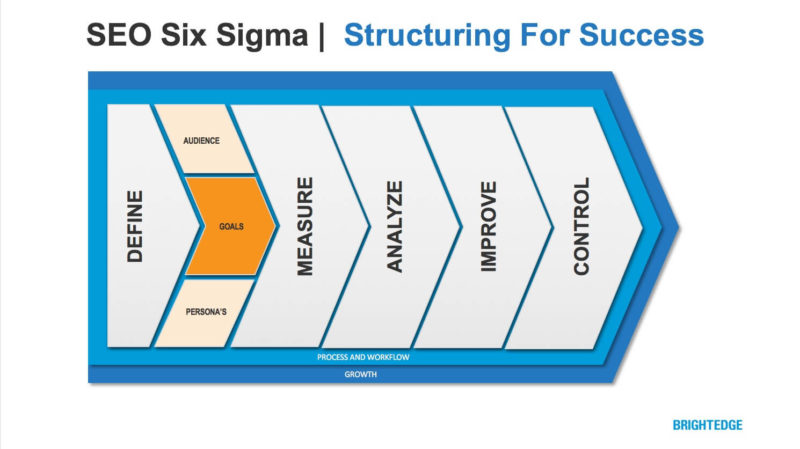
The Six Sigma uses a DMAIC methodology — Define, Measure, Analyze, Improve, and Control — to provide a framework that will help you improve your processes and see strong returns. The tight guidelines that determine each step provide brands with stability and clear instructions about what needs to be accomplished to see the results they want.
SEO Success - BrightEdge

Define

During the definition stage, there are three main things you need to identify: Your main problem, your main audience, and the demand for your products and services.
First, label precisely what the problem is and what you want to accomplish during the process. For example, you might want to focus on revenue, rankings, or share of voice.
You then progress to define who you will be targeting with your marketing messages: your ideal customers. You need to know what motivates people to buy from you and what makes them select your brand over a competitor. The better you are able to understand what your customers want to see, the more capable you will be to provide them with the online experience that they seek. To come up with your target audience, you want to use two main sources of information:
  1. Your existing customers. Speak with them and learn about their pain points, budgets, motivating factors, and why they choose you.
  2. Market research. Uncover the types of people most likely to be interested in your industry and brand.
Bring your information together to begin constructing a few main personas that will tell you what your ideal customers want to see from your brand.
Finally, you need to define what these customers want to see. You will need to outline your target personas with their buyer’s journey. See the types of content that will encourage them to move from one stage of the buyer’s journey to the next. Then use:
  • Keyword research. Identify the topics that have the highest search rates and thus are attracting attention from your audience.
  • Website analysis. Look at the pages on your site that attract the most attention to better understand what people appreciate on your domain and what is already driving people through your sales funnel.
  • Competitive analysis. Look at the topics that your competitors are covering that seem to be helping their sites.

Measure

Once you have finished your definitions, you need to look into your analytics to see exactly where you currently stand. Note your current rank for big keywords, your share of voice, your positioning against competitors, and other metrics that will help you measure your goals.
This information will provide you with your baseline from which you can then improve. You will be able to use these numbers to measure your growth and judge the success you are having.
You also want to look closely at your brand’s SEO processes. During this phase, your main objective is understanding how things are currently being handled internally. You will focus on uncovering problems in the next step. Look at how well your content is optimized and the process your team goes through when determining what to write about, developing the content, and distributing it.

Analyze

Now it is time to move into the analysis stage. Brands must now uncover the problems that have caused their shortcomings. For example, a content audit might reveal that you have significant content gaps and that your material is not effectively moving people from one stage of the buyer’s journey to the next.
You might also find that your material has been poorly optimized or that your domain itself does not carry the authority needed to achieve the highest rankings, for example.
During this phase, work on gaining a good understanding of your competitive environment. You want to see how you measure up to others in your industry in terms of rank, revenue, and share of voice.
Remember that for you to succeed in SEO, you must also outrank the competition. You cannot improve your own positioning without understanding others. Look at what others are doing that is helping them succeed that you are lacking. This might include factors such as:
  • Types of content
  • Changes to the buyer personas
  • Particular targeted keywords
  • Brand awareness and reach efforts– such as more social media or guest posts
Take these factors into account as means of understanding how you are falling short and where you can improve. Look at your internal processes for inefficiencies or failing to take advantage of what your technology is capable of doing.

Improve

In the fourth stage of this Six Sigma model, it is time to improve upon your initial measurements and take steps towards your goals. Take the information you learned during your definition phase about who your target audience is and what their intent is, what they want to see, and what you want to accomplish. Use this information to begin improving your current SEO strategy.
  • Consider the type of content and optimization steps you need to take to reach your goal. For example, social content and thought leadership content helps to grow your brand reach, while funnel content is geared towards increased conversions and revenue.
  • Line up your existing content with the target buyer’s journey to see what you already have available. See how it aligns with the content you need to accomplish your goals.
  • Begin producing the content needed to fill in any content gaps.
  • Cultivate backlinks with a thorough distribution system

Control

Once you begin to see results, you then want to use measurements and analysis to gauge your progress and ensure that you stay on track. You will be able to use numbers to guide your outcomes, rather than hunches or guesses. Implementing these more efficient policies will provide you with more control over the outcomes.
  • Keep track of the adjustments you made that led to the positive changes and write them permanently into the work processes and job descriptions
  • Maintain careful records of your metrics to see your progress and ensure that you do not fall off track
  • Use your momentum to help your organization mature as digital performers. Shift your SEO emphasis towards measurement and analysis, acting based upon your numbers while using technology to improve your optimization efforts.

Final thoughts

As the digital marketing industry and SEO become increasingly competitive and saturated, brands are going to be forced to improve their processes and maximize their efficiencies. The Six Sigma method can be an excellent way to handle this problem and help brands find their way forward.

Saturday, 26 October 2013

Google Ad Words


What Google AdWords’ Ad Rank Update Means for Your Business

This week, Google announced a significant AdWords update: Ad Rank, the system for ordering competing ads on search results pages, now takes into account the anticipated effect of your ad extensions and formats.
To date, Google has considered only your max CPC and Quality Score as part of the Ad Rank algorithm.
Now, ad extensions and formats play a role in where your ads show on SERPs. The projected effect can be the factor to push you past your competition, if max CPC and Quality Score are equal.

Why the Emphasis on Ad Extensions and Formats?
Google has concentrated heavily on building out ad extensions this year, most recently with the additions of review extensions and image extensions in June, and  a mobile-friendly/multi-screen update in August.
Extensions are useful for making ads more useful and interactive; they allow you to share more information in different ways and can make it easier for potential customers to connect. Click to call ad extensions, for example, can be a great thing for local businesses. Google shared research last month that shows 70% of mobile searchers call a business directly from search results.
If you haven’t found a use for ad extensions, you’d better find one quick, because Google’s quiet rollout of the Ad Rank update has a greater impact on all advertisers than one might think – even if you’re not using extensions!
So What’s New With AdRank?
Oh, you know, not much… except that this update means you might actually be penalized for not using ad extensions and your competitors have greater opportunity to influence your CPC.  So, there’s that.
See, using ad extensions raises your CTR and Quality Score, effectively reducing your CPC. The formula to determine what your actual CPC is factors in the Ad Rank of your competitors—if they use ad extensions and see a boost in their Ad Rank, your ad position goes down and your CPC goes up.

This sounds like a great opportunity for a competitive edge, right? If you’re on the ball, have implemented ad extensions and understand how they work, you can effectively influence not only your own campaign performance, but the cost of your competitors’.
Except the way in which Google implemented this change makes their entire advertising pool a sea of winners and inevitable losers. Rather than encouraging advertisers to adopt ad extensions, they’ve made it so that those who don’t may be unwittingly penalized.

Remember that the Google AdWords auction is just that: a real-time, living, breathing auction. Your CPC (note, this is not your max CPC bid, but the actual price you pay) is influenced by what other people were willing to pay for their click. Their ad rank divided by your quality score, plus one cent, is your CPC.
Simply, if your competitors are using ad extensions and you’re not, this change affects you.  Ad Rank affects both your ad position and the cost per click of your nearest competitor. When you are that competitor to someone else, you are affected.
What Can You Do About The AdRank Change?
The update has already rolled out; there’s no grace period here for advertisers to figure out all the nuances of this change and how it may impact their campaigns—and ultimately, their business. This is concerning, especially for SMBs who may already be struggling to keep up with the multitude of AdWords changes this year.
Ad extensions are no longer optional. Yet despite Google’s forced migration to enhanced campaigns, I estimate that as of today, only 1 in 20 small businesses use a click to call ad extension.
Here is what you need to understand and implement moving forward:
  • Expect average CPCs to increase.  As more advertisers adopt extensions, people will have higher average ad ranks. Since your cost per click is directly proportional to the ad rank of your nearest competitor, chances are that CPCs will go up.
  • Watch for less room for organic results in the SERPs. Where is Google going to put all these ad extensions when everyone has them? Expect to see the space occupied by paid advertising further expand into organic territory.
  • Keep a close eye on your campaigns. You’re already optimizing several times a week… right? Probably not, but ideally, you want to be aware of changes in your ad positioning and CPC as soon as possible. You’re now more vulnerable to the market than ever before.
  • Find the extensions that make sense for your business and campaign. The click to call extension might not make sense for you, but maybe discount offers or a location extension does. Get to know Google’s various ad formats and extensions and test out those that seem logical to find the right fit.
The moral of the story is: using ad extensions will raise your Ad Rank, CTR and Quality Score, which reduces your CPC and improves your ad positioning. Remember though that if your competitors are also using ad extensions, that has an effect on your campaign. All other things equal, is that a cancelling out effect, or does one retain an edge over the other? That remains to be seen.