Showing posts with label Local Search. Show all posts

Sunday, 2 October 2016

Content Is King The Same Old Fact

Writing shallow, generic content is easy, requires minimal research and demands little prior knowledge of the subject -- all of which are selling points for content writers. However, clients are looking to stand out from their competitors and demonstrate to their audience why they are the right choice; readers are looking to be informed or entertained with something new; and Google ranks unique content high in search results. Content that just scratches the surface fails to please all three.
The problem is that there is a huge amount of content already on the web, making it difficult for writers to create something completely original. However, by taking a different approach to content creation, you can intrigue your readers and provide value to your audience. Here are a few ideas how to avoid being generic and go deeper into your subject matter.

1. Write from a different angle

You can turn even what may at first seem like an uninteresting subject matter into an exciting piece of content when you consider how you feel about the issue.
Most Creative People recommends sticking to topics in which you already have some interest; however, we understand that this is not always possible. In the case you do have to write on a subject you find boring for a B2B company, never allow your audience to feel your despair. Liven up the content by finding aspects that make the subject compelling, taking an angle you've never tried before. You may not be an expert on the subject matter, but this has no bearing. In fact, limited knowledge can often be beneficial, as you are even more likely to have some fresh ideas that your client's readers had never considered.

2. Infuse pieces with your personality

Nothing makes for more shallow content than facts presented in a bland, dry tone. Your content may be completely free from grammatical or comprehensive errors, but this does not necessarily mean it is well-written.
Enhance your content by allowing your personality to shine through. Pay attention to your choice of vocabulary, style and structure to ensure your writing reflects who you are, while still taking an appropriate tone and voice to meet your clients’ requirements.

3. Experiment with various formats

Mix things up by trying out a variety of formats for your content. For instance, if search results on your subject are turning up many pieces in data analysis form, try a Q&A, opinion piece or how-to instead. Simply by presenting the information differently can be inspiring and may lead you to coming up with a range of new ideas or penetrating the subject in greater depth.
Whether you are tackling a completely new issue or returning to a topic that you have covered many times before, it is always possible to put a new spin on the subject. Keep your clients happy, encourage their readers to come back for more, and improve search engine rankings all by creating something fresh and thoughtful.

Friday, 30 September 2016

Why Mobile Important Now ???

 A little more than a year later, over half of all worldwide searches happen on mobile devices. It’s a big deal in marketing.If your site isn't mobile-friendly, you’re waving goodbye to more than half of your potential. Google wants to help with useful links and tools as well as guides designed specifically for content management systems (CMS). It’s good for you, and it’s good for Google.

A mobile world.

It’s hard to remember the world before smartphones. They’ve changed everything. According to Morgan Stanley, 91 percent of Americans keep their phones within reach 24/7.
We use them all the time for what’s been dubbed “micro-moments,” those countless instances when we turn to our phones for information, directions, to do something, to buy something, to compare, to evaluate, to learn and more.
Consider this: Search queries using “near me,” “close” or “nearby” have increased 34 times since 2011. Among smartphone users, 82 percent use a search engine when looking for local businesses. It must be a magic number: 82 percent of smartphone owners also consult their devices while shopping in a store. With apologies to Stanley Kramer, it’s a mobile, mobile, mobile, mobile world.
Related: 15 Tips for Designing a Mobile-Friendly E-Commerce Site
Talking about “mobile SEO" vs.“regular SEO" is a bit of a misnomer. It’s just SEO. They’re all cogs in the same machine.
That said, if the thought of launching a “mobile SEO" campaign gives you nightmares, it's worth walking through the basics. Take these steps to avoid being penalized by search engines (you need their love) and begin targeting mobile users.

Mobile-friendly is a must.

Mobile-friendly simply means a site looks good and behaves properly on a mobile device. A mobile-friendly site can be designed in a number ways:
  • Responsive. The site morphs depending on the size of the screen.
  • Parallel-mobile. A second, independent site created for mobile users.
  • Dynamic-serving. The server detects and loads an appropriate page depending on the user agent.  
Each type of site has its pros and cons, but a responsive site is the easiest and most cost-effective to implement. It doesn’t hurt that it’s also Google’s official recommendation. You can accomplish this using a responsive theme, for which you’ll find free options and paid options, or a responsive plug-in.
Your first step is to determine whether your website is, in fact, mobile-friendly.
The mobile-friendly test from Google is straightforward. Enter your URL. Google's tool will tell if you're you're mobile-friendly and what you can do to improve your results if you don't pass muster.

Page speed matters.

We know mobile friendliness is a ranking signal. So is site speed. Mobile users expect service on demand: 40 percent of surfers will abandon a site that takes longer than three seconds to load.
Check your site’s speed using PageSpeed Insights. The guide presents both mobile and desktop results, letting you know which features are issue-free and helpfully suggesting which elements need serious attention. GTmetrix is another handy resource.
Next, turn to the Google Search Console for tons of useful tools and advice. To tackle speed concerns, you’ll need to look into your Accelerated Mobile Pages (AMP) data. AMP is a stripped-down, faster HTML designed for mobile users. You can use Google AMP tools to see all pages that implement AMP, identify which of them contain errors and learn what you can do to fix those mistakes.
Pages built using AMP load anywhere from 15 to 85 percent faster, but that’s only the start of the story. You can learn more at AMP Project (including tutorials for getting started). Just be aware it’s not for everyone or every site. It’s best for news-type sites such as blogs, and that’s in part because AMP doesn’t support opt-in forms. Adding AMP to Wordpress is reasonably uncomplicated, and sites using it will rank higher in mobile search-engine results pages (SERPs).
Finally, explore Mobile Usability on the Google Search Console. It reports any existing errors, which might include flash usage, a font that’s too small or a viewport that isn’t configured. Any errors will affect your mobile SEO, so eliminate them wherever you can.

Use Google My Business.

One stop. Done. Want to be found when people search online? Google My Business gets your address, contact details and hours on both Google Search and Google Maps. You can edit it all from one convenient platform. Add photos, respond to reviews and shape how your business appears online.
It’s easy. And crucial. Do it.

Claim your business.

Claim your business and check the details on local directories such as Yelp, Bing Places, Yellow Pages, CityGrid and Foursquare.
These services are increasingly popular, and people use them to find local products and services. Bonus: They’re ranked favorably by the search engines. Follow the guidelines, and make sure everything is up-to-date.
Google Maps may lead the way in mobile location-finding, but Apple Maps still is at the party. Don’t ignore it. Publish accurate information so people can find and contact you when they’re on the go.

Track mobile stats on Google Analytics.

Log in to Google Analytics and conduct some research on your mobile site visitors. Filter those results by day, time and device to discover exactly when your mobile customers are most active. Publish mobile-friendly content (more on that below) at those times to maximize your effect and reach.

Create mobile-friendly content.

Not all content is mobile-friendly, even when it’s on a mobile-friendly site. Focus on these tactics:
  • Bullet points, which are easy to scan
  • Short and concise text
  • Easily shared articles and links
  • Compressed images and videos that do not auto-play, so you benefit from faster load times and less data consumption
  • Meta-title and meta descriptions that are short and to the point -- perfect for mobile displays
Time of day is a factor here, too. Publish shorter content during morning and afternoon commutes and longer pieces during typical lunch breaks for your target market. Save your longest content for when people are likely to be at home. And remember, mobile users often look for informational content.

Use local keywords.

When conducting keyword research, be sure include local vocabulary that might be unique to your area. Think about terms and slang that don’t appear anywhere else: nicknames for neighborhoods or the city itself, colorful and relevant expressions, regional specialties or whatever.
When people search for you online, what language and words might they actually use? Target them.

Optimize for voice search.

People are talking to Siri or Google Now more than ever on their smartphones. In fact, 20 percent of Google searches on Android are now done via voice search. That amounts to hundreds of millions of inquiries, with 55 percent of teens and 41 percent of adults using voice search at least once per day.
Voice search is the better option when walking (or driving -- which you shouldn’t do). But it does have its own set of criteria. Voice-search queries tend to be more conversational. We pose a question or ask our phones to perform a task in the same way we would talk to another human being.
Craft your content to match those specific, real-life questions and optimize for the three biggest voice platforms.

Remember the takeaway.

There’s a lot more you could do, but this is a great jumping-off point. It is the beginner’s guide, after all.
If you take away only two things, these are it: Make sure you’re mobile friendly, and remember that page speed matters.Mobile optimization will get only more important. Don’t be left behind.

Saturday, 24 September 2016

Make Your Digital Marketing to the Customer Experience

As much as two decades ago, the way consumers seek for buying brands depended on how much the brands were able to thrust their products into the consumers’ vicinity and at the same time, appeal to their taste. For instance, a commercial soap ad in between a TV series or a radio program, would be enough to sway consumers’ preferences of buying a soap product. In fact, that gave rise to the term ‘soap operas.’ Procter and Gamble (P&G) would produce radio and TV shows so that they could advertise their products during the breaks.
Fast forward to 2016, and you will see that brands have drastically changed the way they communicate with consumers. In the Internet era, brands push their products to their consumers in the form of recommendations. That is why Amazon and other ecommerce sites are able to execute targeted ads in the form of suggestions and recommendations.

Today’s technologically-savvy consumers are more informed and knowledgeable, and are moving out of the traditional route of researching and making purchasing decisions about products. They research well before buying a product or a service. This post that highlights ‘from search to store’ by Matt Lawson does great justice about how brands must ‘deliver on expectations in moments that matter’. Then the pertinent question to digital marketers is:
  • What is our customer's’ decision making journey?
  • Why and how should we align our digital marketing strategies that will fall in place with the customer’s decision?
Let’s give a quick look at what our customer’s decision making journey looks like: Recognition → Familiarization → Consideration → Purchase
The idea is to avoid premature optimization in marketing. We don’t solve a non-existent problem, when it comes to engineering. But we identify a problem and build a solution around it. Similarly we must focus on the right things at the right stage when it comes to digital marketing.

Recognition.

If you think about building a business, your website would be a natural location to showcase everything about your business and product. And one way to build maximum awareness and recognition is by generating traffic to your website. So, your first objective would be to get, say, 100 visitors a day, and then, 1,000 visitors a week.
37Signals wrote an interesting post on how they built the buzz with their side projects. “It takes a lot to differentiate your brand in today’s “me too” world of electronic business solutions”, it says. And it is very important to engage in such projects that will ensure that traffic is headed your way -- consistently. How:
  • Hang out where your audience hangs out and sign out with your website details -- answer relevant questions on Reddit, HackerNews, Quora etc., so that the audience learns of your expertise in the space.
  • Use Call to Actions at different places on the site so that the visitors are engaged and are compelled to explore the website, rather than opt for an early exit.
  • Invest in SEO efforts to drive organic search traffic to your website.
  • Paid Search is one of the most effective ways of driving traffic to your website, but businesses must be able to justify the expenses while measuring the outcome. (Here’s a hack - you could experiment with a paid search channel like Google Adwords even before you build your product, if you have the budget. This works well as a research tool, to see if the product you are building has demand and will sell).

Familiarization.

Right, now that you have a 1.000 potential leads visiting your site, how do you familiarize them with your product? How do you ensure that they know what they have signed up for? Customers rely on their common sense of familiarity of choosing a familiar and known brand. How do you feature there? Simple - meaningful and engaging content.

Content Marketing found its origins in 1891. More than a century ago, August Oetker, the German inventor of baking powder - Backin, sold packages to households. What made Backin a familiar brand was the little recipes printed on the back of these packages. In 1911, he published his cookbook and over 100 years, it reached a global audience with about 19 million copies. That was the first example of content marketing.
It’s 2016, and that’s still pretty much how we could do it too along with the added advantage of using social media. With the right message and relevant content, across mediums, marketers should focus their attention on their target market.

Consideration.

The top of the mind problem for a brief time is signup conversion. So you move to the next stage, which is user engagement. Now, here’s the thing about brand consideration. In today’s digital world, consumers speak with brands as much as brands speak with consumers. In this two way communication, you would need to empower customers to explore your product, to play around the sandbox test site, to ask questions. How:
  • Two way engagement with customers
  • Test and prioritize objectives. Optimize CTAs. Here are some great posts on optimizing CTAs by HubSpot and CrazyEgg.
  • Treat pricing as a filter. Change pricing to attract the right audience that you need.

Buying.

Now you are happy with user engagement, why aren't they converting into paying customers sooner? How:        
  • Continue making tweaks -- tweak application onboarding process.
  • Setup demo calls with prospects to understand their business requirements and make  suggestions on how your product can cater to them.
  • Fix application onboarding with drip emails, simplifying documentation, product and measure time it takes for customers to go-live.
While you are at it, rinse and repeat what is already working for your business to bring in more traffic. With hundreds of such iterations you now have a pipe instead of a straw to convert visitors into customers. A positive user experience through all these bottlenecks will ensure that your customers who have now bought your product will spread positive word about not just your business, but your attention to detail to improve customer experience.

Friday, 23 September 2016

Truths About the Internet Marketing World

Wherever you look, you're inundated with advertising for varied merchandise and services from web marketers. you cannot scroll through Facebook while not seeing a poster for a few webinar that guarantees the key system to create six or seven figures with their signature providing. you would like to grow your business and make freedom therefore these offers square measure tempting.


 The scariest a part of the net selling world these days is all the cash that's being spent on coaches, courses and digital data merchandise that solely deliver promotion. it is a nice chance for on-line entrepreneurs to grow revenue however there square measure over a number of dangerous apples (as in any trade) that square measure symptom the name of the industry normally. Here square measure 5 arduous realities of the net selling world these days.

1. The sales copy is better, leading you to buy things you don't need.

Over the years, marketers have gotten better at finding your emotional triggers and creating copy that plays on those triggers. Don't misunderstand what I'm saying. I'm definitely not saying all marketers are shady or that writing to emotional triggers is always wrong. What I am saying is that the copy is designed to make you feel a certain way and take certain actions that will eventually lead to a sale.
When making a business decision, you have to keep your emotions out of the equation as much as possible. Look past the copy, and evaluate what the practical takeaways would be and how they would benefit where you are in your business right now. Look at the offer; study the testimonials; and examine the person, who is teaching, to make sure they know what they're talking about.

2. The premium content doesn't go deep enough.

Too much of the premium Internet marketing offerings are designed for one thing: to upsell you on the more advanced offering. You buy one thing, and you are constantly being upsold on something else. The content gives you advice, such as create good content, but it doesn't tell you what good content is, how to create it or the most effective ways to market the good content. To get those next steps, you have to join the exclusive next step.
If you are thinking about investing in information training, make sure the training goes as deep as you need it to. Don't be afraid to ask questions or talk to others who have taken the training. Make sure you are going to get the type of information and strategies you can use for implementation and growth.

3. You don't get the personal support you need to actually make progress.

One of the biggest downfalls of online based training is that you can't get your questions answered. There are a lot of courses that are simply a talking head video, and that's it.
When you start implementing and have questions, you don't have the option to get them answered. And, if there is a private group for the program, the marketer isn't usually too active in the group. Don't invest in training where you can't get your questions answered. And, you will have questions.

4. You are pushed to spend beyond what makes you comfortable.

A common upsell tactic in Internet marketing is when you are convinced that you don't care about your growth and personal development if you aren't willing to spend crazy amounts of money.
It's just not true. You can care about your personal development without going broke by buying a certain course, product or investing with a certain coach that you can't afford or whose training is way too advanced for you.
Yes, you want to push yourself out of your comfort zone, but only where it makes practical sense. You don't want to spend the rent money in the name of personal development and growth.

5. You already have the resources you need to grow on your own.

There is a wealth of free information through videos, podcasts and blogs that have the information and strategies that can help you grow. The reality is that we, as humans, consume too much information. You probably have more knowledge about a topic than you realize. Use what is avaiable for free. When you hit a wall, think about what investment makes sense to get you to the next level.
Before you spend money on a coach or a course, make sure you have thoroughly done your research. Make sure you are in a position to benefit from the training. There are many great investments that will be good for your business, but only after you reach a certain level. Don't be fooled by sales copy that makes it seem like you need to spend money right now. Know yourself, and know your business.

Thursday, 22 September 2016

Guest Posting

It is great idea to connect with most of the prominent people in your own industry.So  when we consider it important then we would start thinging about the guest posting.Pay attention to the title, Steve. I said publishing, not posting.

Guest posting typically starts and ends with the aim of link building. It takes no time to degenerate into “wildly getting your content posted anywhere you can manage for a backlink” strategy.
What good is that?
When you say guest publishing, you are aiming to get your content (and by extension – your name and domain) plastered on some of the top ranking and highly revered online publications for your industry vertical. If you are a web developer, aim for Smashing Magazine. If you are an inbound marketer, shoot for Inbound.org, Unbounce, KissMetrics, and so on.


Getting featured on a well-known, niche-relevant blog/publication will place you as an industry insider/subject-matter expert in your target audience’s mind.
This gives a massive boost to your online reputation. This is the kind of content you can talk about at dinner parties (with other similarly-inclined guests, obviously).
A strategic link placed on your website to this post (once it’s published) will get you SEO points (link juice), and of course, a nice portion of audience as referral traffic.

Must Have SEO Optimizations You Can't Afford to Ignore

The technique of  Search Engine Optimization strategies have shifted dramatically throughout the years. Most marketers understand the need for allocating some of their budget towards new SEO tactics. Nonetheless, you need to invest in SEO because it gives you more targeted advertising, it is not as expensive as you think, and hey — your customers expect to find you when they search. With that in mind, here are nine SEO optimizations that you can not afford to ignore.

1. Anticipate the Intention

Contemporary SEO practices show that you no longer need an exact keyword match to provide a relevant search result. These days, search engines want to see how people are interacting with your website. Are they coming back for more? Is your site providing them with the right answers? In the past, SEO was focused on getting clicks. Today, it is revolved around post-click activity. Furthermore, you need to satisfy your searcher’s intent as well.

2. Deep Links Via Apps Are Growing in Importance

Mirroring a demographic shift toward mobile users accessing the Internet, Google has been indexing apps for several years. Google believes, as do many others, that apps will overtake traditional websites with regards to functionality and popularity. This is why deep links to apps are a growing trend.
They are essentially links within apps that point toward specific pages. Accordingly, you’ll start to hear the term “app optimization” more often. So, if you don’t have an app you should consider getting one ASAP. If you still want to wait it out, then at least get your business listed on as many other apps as you can.

3. Mobile Optimization Will Overcome Desktop Optimization

We’re all used to using the desktop for search. However, 2016 was the year that mobile searches finally outstripped desktop searches. This shift will not likely stop. Some analysts believe that the desktop will fade into obscurity within five years. In fact, Google even announced that a desktop-specific site is no longer necessary.

4. Page Speed Is Critical

One major ranking factor with website pages is speed. With mobile outpacing the desktop, who has time to wait for a page to load? Think of it this way: all else being equal, the site that loads faster will always outrank the slower page. Not to mention, a slow-loading page will waste your site’s crawl budget. Why? Because Google bots won’t stay on your page for longer than a specified time frame.
The slower your pages load means the fewer chances you have for them to get indexed by Google. Yet, there’s more. Page speed is essential for user experience. Instead of watching your rank drop faster than a hot potato, optimize your page load speeds today.

5. Digital Assistants Are Changing the Game

If you haven’t already noticed, an increasing number of queries are started by digital assistants such as Google Now, Siri, and Cortana. This makes search a bit more complex. To illustrate, spoken language queries are a bit different from typed queries. This means a new form of long-tail keyword queries that emulates spoken dialogue is coming into play. As a result, pages may rank higher if they have conversational content.

6. Google Values Content Marketing

If you want to provide value to your visitors, you need to invest in content marketing. Of course, you have to provide the solutions to the problems your followers are looking to solve. Just do a basic search for something you find interesting. Many articles on the first page are lists and how-tos. This is because they are the types of articles people want. You have to figure out exactly what your audience wants, and serve it up to them on a Google platter.

7. Social Content Will Gain More Relevance

Since Google already partners with Facebook and Twitter, you’ll find that if you search for a news item, a few tweets might appear in your mobile search results. In 2016, more networks will be more heavily indexed. This means that social posts will like carry more and more value. There will no longer be such a distinct separation of “web” and “social” media. So, by all means, post away.

8. Don’t Forget Local SEO

You just can’t forget local SEO. Since Google’s Pigeon update, local SEO has been imperative for every single business that wants to rank well. On mobile devices, 50 percent of desktop searches have local intent.

9. Optimize for Rich Answers

According to Stone Temple Consulting, Google returns “rich answers” to 35% of search queries. That’s a significant increase over the past few years. Many times rich answers are based on public data. For starters, you need high-quality, unique, proprietary content. This is because the rich answers Google uses often come with external data and a link to its source.
If your page is featured in a rich answer, you will certainly experience a spike in traffic. The good news is this can happen even if your site’s authority is not yet very high. An example of rich answers are Wikipedia snippets you find in your search queries. To get the same profile you would:
• Begin with longtail keyword research.
• Find the most commonly searched questions in your industry.
• Curate content that answers these questions. Include the question and direct answer.
• Provide additional information on the question at hand.
• Make sure your content can be found by Google bots, your social accounts and through your site’s navigation.

Conclusion 

The SEO landscape is constantly evolving. Make sure your website and your search marketing strategies evolve along with it.

Monday, 19 September 2016

Instant messaging: An introduction to the future of communication

In recent event Mark Zuckerberg said “(Instant messaging) is going to be the next big platform for helping you connect with all kinds of services in new ways".

When you bear in mind this is a man World Health Organization spent the best half of $22bn shopping for WhatsApp, you'll be able to be pretty certain he’s about to be right. however wherever is instant electronic messaging heading and what will this mean for marketers?

For those of you that don’t recognize – I’ll assume you want to are treed on a desert island for the past few years – instant electronic messaging (IM) may be a catch-all name for a spread of various services that primarily give users with the chance to have interaction in time period communication.

Typically crystal rectifier by text spoken language, messengers usually additionally give a spread of extra practicality that varies wildly from supplier to supplier.

This additional practicality has, on some platforms, crystal rectifier to them being thought-about as full-blown social media networks, on a par with Facebook, Twitter and different platforms.

In 2015, mobile electronic messaging apps were employed by one.4bn shoppers and eMarketer predicts that, by 2018, the amount of chat app users worldwide can reach 2bn, representing eightieth of smartphone users worldwide.

In a shell, it’s solely a matter of your time before everybody and their granny, in much each country on the world, square measure exploitation IM.

It’s a promising begin, but kik has seen little uptake out of the United States and it’s still dwarfed by the progress of WhatsApp and Facebook courier for the instant a minimum of.

So who are the Big Players?

WhatsApp
Owned by Zuckerbeg & Co. and with over 1bn users, most of which are tech savvy millennials, WhatsApp is the clear front-runner in the IM community and the only truly global IM service with any significant uptake in all continents around the world.
Offering text chat, voice recording, media sharing, group broadcasts and a robust network, you would surely bet your house on this IM giant being the one to pave the way for the future of IM [insert smiley face emoticon].

whatsapp

Facebook Messenger
Formed from the online chat function of the social network, Facebook Messenger has made real inroads in the EMEA and US regions with over 800m users.
However it’s clear that with certain restrictions in places such as Asia, its move out of these two markets and into the APAC region will be a tough one to tackle.

WeChat
With 650m users, primarily in the APAC region, WeChat is, significantly, dominant in the Chinese market offering users the chance to chat in a ‘walkie talkie’ style conversation, as well as other typical features such as group chats and video calls.
WeChat is also a social network and an extendable transactional platform. It gives its users the opportunity to shop, talk to brands, order taxis (its ‘Didi Dache’ service is essentially China’s Uber) and read the news.
WeChat is also the only social platform 80% of Chinese millennials use every day.

Kik
With over 240m users, kik has its biggest presence in the US with an impressive 42% of US users being between 16-24 years old.
It’s a promising start, however kik has seen very little uptake out of the US and it’s still dwarfed by the progress of WhatsApp and Facebook Messenger for the moment at least.

Others?
Though there are some exceptions to this global picture – KakaoTalk is the most popular chat app in South Korea, for example, while Line dominates in Japan, Thailand and Taiwan – there’s no doubt that it’s Facebook that’s winning the race so far.
And before you say, “but what about Snapchat?!”, though this service is doing some serious business with teens in the UK and USA (over 40% use it), one a global level it’s still early days with only 7% market penetration.

The future of IM

With the landscape of IM changing and its scope reaching all aspects of the user's life, both personal and professional, it’s clear to see that IM offers real opportunities for businesses to get involved – but how will this play out?
Firstly, IM is not a place to advertise, it’s a place for marketing. It gives us a powerful new space for brands to change the way consumers think about retail and customer service.
The promise of IM is that if offers a near perfect form of personal, intimate, direct link between brands and customers.
Facebook Messenger has already started to make real inroads in expanding the capabilities of its own IM platform, recently announcing the introduction of so-called chatbots.

Similar (but arguably less advanced AI) has been prevalent in WeChat and other channels previously, but inclusion in Facebook Messenger is likely to see increased quality of functionality.
Chatbots will offer the ability for businesses to create bespoke responses based on natural language input.
As the use and complexity of chatbots expand, users will find themselves being able to order goods simply by messaging the brand – as users of WeChat are already doing – receive tailored news updates based around your interest and even control connected smart devices.
The future of commerce and customer service could well be a hybrid of IM as it steadily becomes our primary way to interact with companies, buy things, provide service and build loyalty.
As the big players (and the many smaller innovators) continue to expand and develop the platforms’ potential, it’s safe to say we’re only at the beginning of what looks to be a long and interesting road.

Saturday, 17 September 2016

The Building Blocks of Digital Transformation

Use new Info graphic as a checklist for planning digital transformation across your entire organisation

It is true that digital transformation is an incredibly complex undertaking, particularly in larger organisations. But given modern consumers' propensity to demand more from brands, it is not optional. Businesses have to become more adaptive and quicker to utilize the latest technology to improve the experience of their customers. If they don't then they'll rapidly find themselves disrupted by more agile competitors.
Too often companies recognize these trends but fail to transform successfully. They start a digital transformation process because they feel like they should, but do not integrate it across departments. Worse, they often focus on attempting to use new digital tactics whilst failing to actually develop a cohesive digital strategy.

This leaves a mesh-mash of different systems which can lead to massive headaches when they inevitably either leave gaps or clash. What is more, trying to focus on digital tactics without actually integrating them into an overall strategy means they'll usually fail to deliver actual business goals and instead leave marketers chasing vanity metrics like 'likes' or 'followers'.

The way to prevent this, is to start with setting business goals with specific SMART digital channel objectives and work down, rather than starting with tactics and working up. Once well thought out goals are set, you can set to work working out how you can break down silos between different components of your business by aligning them with these goals. Then comes developing a proper strategy. To do so you'll need to draw on planning methodologies like SOSTAC® and digital marketing models like the RACE framework. Not to be discounted are the traditional marketing models such as the 7Ps which will help to align digital and traditional channels into a single strategy.

When you have a proper strategy in place, you should consider how you can continue to improve by constantly measuring and optimizing. No battle plan ever survived contact with the enemy, and no good strategy lacks provisions for further tweaking based on evidence. So when planning your transformation process make sure to consider how you will gather data on the success of your efforts and crucially how you will then turn that data into insights and act on it. An analytic department that does nothing but report to suits at the top without anything ever being done as a result may as well not exist.
Only once all those building blocks are in place should you start to consider what tactics you will use. The info graphic provides a pallet of tactics you may want to draw upon, but which ones you chose to invest most in will depend on the nature of your organization. Use this info graphic as a checklist to make sure you have all the necessary aspects of digital transformation in place. Once you've started developing your strategy you'll want to download our free digital transformation briefing to further understand the pitfalls of digital transformation and how to avoid them or, if you are serious about making change happen in a larger business.

Friday, 16 September 2016

Why Digital Marketing to Transform Your Business ??

In the era of technology Is your company fully embracing the digital age?

Is your team engaging digital transformation beyond updating your website every 6 months?
For many companies, failure to adapt to new technology means getting left behind and losing business. Your prospects and customers are researching and buying online, so why aren’t you focusing on marketing to them via digital channels?


Ask any millennial about Kodak and they will struggle to tell you more about what it does. For many of us however, Kodak was a household brand and a former heavyweight in the analog film business. Kodak not only missed the boat on digital but also acutely misunderstood the ways consumers wanted to be engaged, interact with their photos and the technologies involved. As a result, Kodak filed for bankruptcy in 2012.

For companies like Kodak, to stay in business, they are forced to make desperate cost cutting measures starting with employee layoffs. Often, these layoffs start from traditional cost centres like IT, Human 

Resources and Marketing. During layoffs planning, the company looks at departments that are unable to prove return on investment (ROI) and are adding to the cost of running a company.

When the marketing department gets downsized, it can be difficult for marketers like us to accept. After all, marketing has always been in charge of bringing the product to market. The reality for most marketing departments is that they have a long list of complex strategies influenced by a mix of internal and external stakeholders. We are bogged down with a host of business functions such as increasing brand awareness, product adoption & pipeline creation, resulting in being tied down with more projects than we can handle, which means proving the ROI can get left behind.

But how do you know what’s working for your business if you can’t measure the effectiveness of your marketing campaigns?

Let’s compare this outlook with the sales department, which operates under a constant sense of urgency because they are always working to meet a predetermined sales quota. This sense of urgency is exacerbated by the fact that their compensation is tied to meeting or exceeding those quotas. This gives them an extraordinary sense of focus around measuring their results and reviewing their strategies.
There’s no reason why marketing can’t work towards targets in the same way sales does.

Work Out What to Focus On
In order for marketing to be empowered as a function, we need to cut out the noise and confusion that can make it difficult to focus on objectives that matter the most; those that ultimately drive sales and prove ROI. At a high level, these objectives should address the Top of the Funnel , Middle of the Funnel and Bottom of the Funnel : -


  • If you need to increase traffic to your website, utilize tactics like blogging, Search Engine Optimization & Social Media
  • While blogs are very effective at bringing visitors to your website, they won’t help you qualify prospects or make a sale. To turn visitors into leads, Middle of the Funnel  tactics like ebook offers & webinars will help you get there
  • By the time a lead reaches the bottom of the funnel, they are ready to buy and the only question is who they will buy from. This is the chance for marketers to add more qualified opportunities to the sales pipeline by using tactics like lead nurturing through email marketing & case studies
Once these objectives are top-of-mind, the marketing department can devise a strategy that turns them from a cost centre into a profit centre, fully capable of explaining results and impacting the company’s growth.

Monday, 12 September 2016

Digital Marketing In Nut Shell


Digital marketing comprises two basic words digital and marketing digital means the mean of technology in the form of computers and other communication devices.Marketing is kind of strategy that companies usually
Implements to promote their products in market in such a way to fetch maximum profits while selling them.

The field is vast as it is majorly ruled by the consumer behaviorism added with all this there are many ideas in technology section that changes many folds with time.So it’s like using the technology as a change to market the products on a broader basis ignoring the door to door salesmanship theory that is time consuming and yields limited results.  

With every promotions online the users has the advantage to go through the overall specifications and reviews of products but in a way it has now become challenge for companies to provide consumers products keeping in view the image the product’s brand has made online like wise good reviews surge sales online but dips profit margins with bad reviews.

Sometimes the unusual behaviors of consumers also becomes a major factor in failures of promotions and its great that we have analysis tools such as Webmaster and Google Analytic s and provides us with demographic data that helps us draw a line and determine whether a promotion is going on well or we should have a change strategy. 

Every marketer needs to understand how to exploit digital marketing assets, tools and techniques in order to improve their customer value proposition and help achieve their organisational objectives. This means designing an accessible, usable and value-adding website and using a range of inter-related digital marketing tools and techniques – integrated with traditional tools and techniques – to drive traffic, conversion, engagement and referrals. 

Sunday, 11 September 2016

Digitizing traditional marketing methods to compete in local search


maps-commerce-local-business-sales-discounts-shopping-ss-1920


In case of local brands and companies, it can be harsh to initially bridge the gap between traditional and digital marketing. Many local companies, even very successful ones, see more value in traditional marketing methods than inbound digital engagement.
Recently, we’ve seen brands increase local search performance by digitizing traditional marketing methods, translating offline to online marketing. Local businesses that are struggling to understand how to make the move from traditional to digital can follow a few strategies.

Use hashtags correctly

In early 2015, Google and Twitter partnered in a way that allowed Google to collect information and have access to Twitter’s data stream. This means that if your local campaign is running on hashtags across various digital touchpoints (mainly Twitter), you can use this to increase the strength of your local search presence.
Work on incorporating hashtags into printed and other materials to encourage your audience to take the conversation online. The hashtag you create should incorporate a keyword with high search volume that speaks to your brand and the goal of your campaign.

Red Door Interactive focused on running a campaign that bridged the gap between traditional and digital marketing using hashtags. It ran a campaign for ASICS that created a seamless offline to online digital experience to connect with the local New York and runner community to garner local interest during the 2015 TCS New York Marathon. Red Door Interactive’s push to elevate ASICS in the local search landscape developed with harnessing the importance of race day supporters.

Knowing that supporters hold up encouraging signs to runners, a sign generator was created so that supporters could customize and print their own signs. The community was able to customize signs for the race online, share the signs to various social networks with the hashtag #GoRunIt, and finally print the signs which accomplished bridging the gap between offline and online.

Lisa Brown, a real estate agent, shows this practice in a more local environment. She created a hashtag for her real estate services and found a way to digitize traditional marketing by including the hashtag on her billboard. Furthermore, she has found a creative way to understand some of the ROI that the billboard offers using digital marketing. Those who submit a photo of the billboard and follow her on a social channel are entered into a contest.

Local Hashtag Example

When the hashtag is seen in printed material, the audience understands that using that hashtag within posts or conversations online can help further engage with the brand or others searching on the hashtag.

Garner inbound links and press around an event

As you develop a product or event for your local brand, think about how the PR surrounding it can be translated to digital. According to Moz’s 2015 Local Search Ranking Factors survey, link signals are among the top ranking factors for local SEO, and we can use this information to our advantage.
Go to the press, or submit press releases through paid providers (PRweb.com, for example) to increase inbound links to the site. Your website’s domain authority will increase depending upon how credible and trusted the websites are that provide you with an inbound link.
Developing an event or product that is worthy of press can help increase inbound links to your site which works to increase positioning in the local pack.
Take what you’ve done offline, and make something noteworthy of it that people will want to write about. Then measure the inbound link benefits and see how it translates to elevating local search performance.

Pursue inbound links from people already talking about you

Find sites that mention your business, and reach out to the webmaster for links to your site. After all, if a website is mentioning your company, you should be getting an inbound link from them to help increase your local SEO.
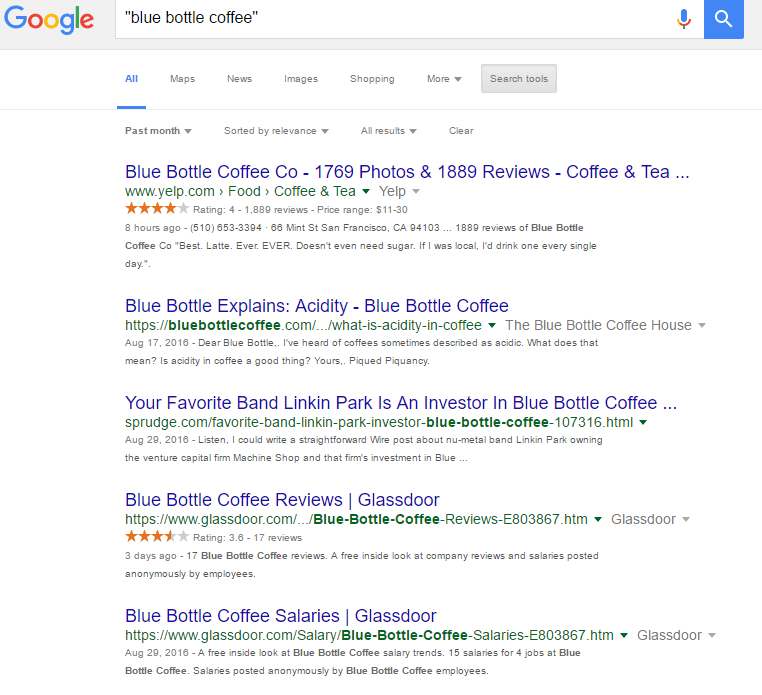
You can find sites that mention you by going to Google.com and typing in the name of your business in quotes. From here, identify listings where a site mentioned your business but did not link back to you.
Identify that site’s domain authority to determine how important it is to garner a link from the site. If you find that the site has substantially high domain authority, it is worth investing your time into garnering a link from the webmaster. The example used below is from Blue Bottle Coffee. This is the type of search I would perform if I was wanting to find listings where Blue Bottle Coffee is mentioned within the past month:

blue bottle coffee inbound search

Create an incentive for your audience to get digitally involved

Maintaining a relationship with your audience online is critical for a variety of reasons. Updating your customers on new products, services, or sales can all be done at little to no cost, on a moment’s notice, and excite conversation around your brand.
For local businesses with a loyal following, it can be hard to get customers to engage online. Recently, we’ve seen more local businesses prompting their customers to bridge the gap between online and offline.
The Backporch Café, a local restaurant to Fort Collins, works to get its customers online in an effort to bring its food to the forefront of people searching for restaurants in the specific area.
In the image below, we see that The Backporch Café is working to gain more impressions online through social media by encouraging current customers to post a photo of a meal and use branded hashtag.

Digital Incentive

While this may not directly lead to gains within Google’s local pack, anything that increases a business’s visibility online has the potential to indirectly impact local SEO efforts. By spreading brand awareness, you can increase searches for your business and improve site authority through inbound links.

Get started

We rarely think about how we can improve local search performance by digitizing traditional efforts. However, connecting your offline and online marketing strategies can significantly help increase local search optimization efforts and connect a more traditional audience to the online world.
With competition as fierce as it is within local search, we need to find ways to improve local search performance without sacrificing those who respond to traditional marketing.
Start with some of the techniques discussed above, and work from that to a larger offline-to-online campaign to help strengthen local impressions.
When a campaign’s purpose is to drive digital local engagement and increase local search positioning across directory sites, continue to think about how your brand can begin to digitize its traditional marketing.